Monday, 16 July 2012

to travel or not to travel..

Every time I come back from a vacation, I wish I could pack my bags and leave once again. Where I would take off to would almost not matter. My whole being would simply desire a taste of another road untravelled, another city/town unexperienced.

Countless times I have told friends of the longing to just drop work and hit the road for that next bit of adventure that will add to my repository. But alas, this is not always immediately possible. Life loves to quickly sink its teeth into you like a crazy dog and not let go. Yes, life’s a bitch that way. But it loosens its grip every now and then. In the interim, there’s work to return to, obligations and responsibilities to continue fulfilling.

So often you read about people who talk about travelling for 3, 6, 12 months at a stretch. They come back with bagpacks full of dirty clothes, torn underwear, and more importantly, a treasure trove of memories and experience. They describe their time away as ‘awesome’, ‘mindblowing’, ‘life-changing’. Of course, I’m thrilled when people get to travel and sometimes I even suggest places they should go to, things they should see/visit. But I’m only human, and have to admit that these gap travellers do make me jealous sometimes. And that’s only because I wish I could do that too.

Of course you can, someone once told me. Everyone only says they want to do this and do that but choose not to. Yes, he pinned it down to ‘choice’. I agree to some extent. Some of my friends say they are envious that I’m always (in relative terms) jetsetting. And I’m usually puzzled by such comments. A number of them easily earn more than me. How is it that they cannot afford to travel then? I’ve got a car, I need to save up for my condo, etc, they tell me. So there. People have priorities. Some they don’t want to give up (like a car), others they simply cannot. And it is this latter group that I come from as well.

It’s not as if I’ve always been able to afford to travel. My mum’s not rich, and she spent most of my growing up years struggling to raise my sister and I. At the same time, I used to be in awe of my youngest aunt who would slip out the door with her sleek trolley bag for her next flight as a flight attendant. For a long time, I was happy enough receiving postcards from her jaunts.

Then until 2011, I could only dream of ever stepping foot into Europe, given the cost involved. But I managed to save up and cut back on expenses (not like I spend a lot to begin with). It also helps that the euro has weakened dramatically against the Singapore dollar. The arrival of certain airlines also meant I did not have to pay a foot and an arm for a seat on the plane.

But not everyone is able to do this. I once thought of moving to India for work. A friend there said I had lost my mind: how do you think you’re going to travel if you move here? Well, there’s always India, isn’t there? I’ve not been to every part of the country. But his point did not fall on deaf ears: there are people who struggle to make ends meet. Their main concern is putting food on the table for themselves, for their families. To hop into a plane to some faraway destination is something that’s better left to characters in a film.

For some people, getting visas is a nightmare. I had a glimpse of this problem when I tried applying for my visa to Bangladesh in late 2009. Some people wait for months for their visas to be approved, only to be rejected. A Pakistani friend of mine has not been allowed entry into Indonesia for the longest time. They’re probably worried that I’m some militant, he joked (all he wanted to do was to soak up the sun in Bali). The other problem is one of high-level politics: your country and mine are not buddies.

Travelling is no doubt an experience like no other. It teaches you so much about the world, about life, about yourself. It reminds you that no matter how much you think you know, there’s so much more that you will never fully grasp. This includes the reasons other people cannot travel.

Those who choose not to...well, that’s their loss.

Monday, 9 July 2012

In the city of "Before Sunrise"

Soon after returning from my trip, I remember watching "Before Sunrise" (starring Julie Delpy and Ethan Hawke) again just to catch glimpses of the places the characters left their footprints. 'I was there too!', I exclaimed to whoever was watching the film with me. Maybe it's just me, but there is something about seeing images of the same spots you've visited on the big (or small) screen. Strange as it may sound, for me there is a sense of childlike pride for having been there, having seen the city. The image on the screen affirms the city/town's worth and beauty which your own words may not convey. Then again, maybe it's your own images that make people sit up and pay attention to a city/town they would have otherwise not thought of as a travel destination. Here then are some of my own images of the Austrian capital. Hopefully they inspire you too. :)


Start off in the west of the historic city-centre where you will find the Schönbrunn Palace (left). It is the former imperial summer residence of the Habsburgs and has just over 1,440 rooms. Of these, 40 rooms are open to the public. Audio guides are provided for a more comprehensive tour. Before or after you wander in the rooms, take a stroll around the gardens and walk up to the Gloriette, a structure that houses a cafe and offers generous views of the city. In the historic district itself, you can wander around the Hofburg Palace. The area here has been the documented seat of government since 1279 for various empires (including the Austro-Hungarian) and republics. It now serves as the residence of the President of Austria.

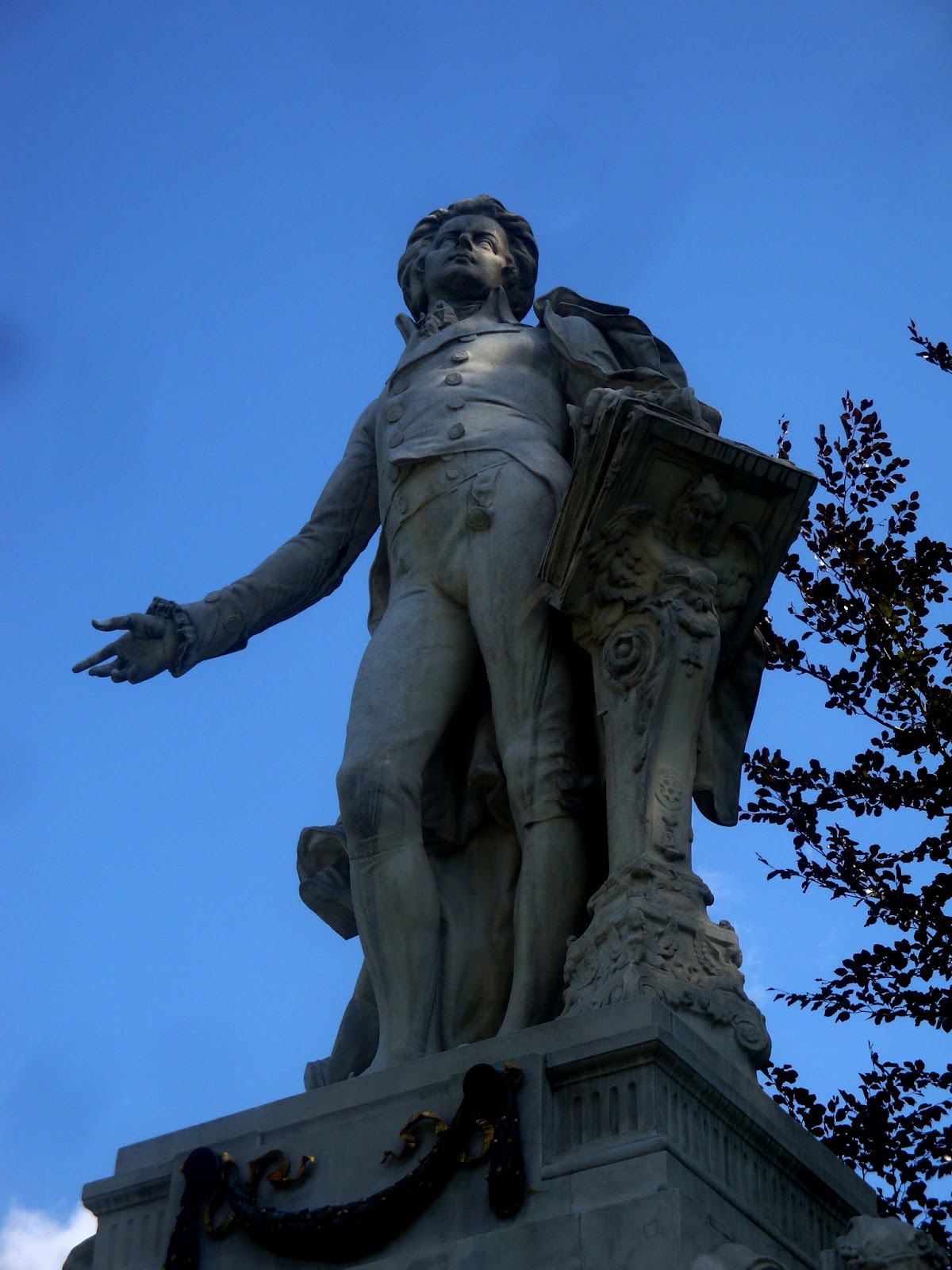
Walking around the many parks in the city centre might bring you face-to-face with this statue on the left. That's
The conductor expects some level of audience participation too
Mozart in Burggarten. Loitering around here you should find a couple of modern day 'Mozarts' selling tickets to classical concerts. I paid 42 euros for my ticket (in June 2011) and it was quite worth the price. The best part is that you don't have to be fancily dressed for the event because it caters specifically to tourists. So go on, let your ears feel music as it once was.
View from Leopold

Vienna is also home to many museums (the lady at the hostel told me there are at least 100). Chief among them is the MuseumsQuartier in the historic city-centre, where you will find the Leopold Museum (showcases the works of Egon Schiele and Gustav Klimt) and Museum of Modern Art (or MUMOK, which was closed at the time of my visit). Only if you're into architecture should you venture into Architecture Center Vienna (Architekturzentrum Wien). Don't get me wrong, it's not entirely technical; it's a one-room exhibition space detailing what went into the planning of the city. Away from MuseumsQuartier, other art spaces include the Belvedere (above left). There is also the Wien Musuem at Karlsplatz which traces the history of the city.  

Hang around Resselpark after you're done at Wien Museum; have a simple lunch of kebab or sandwiches (there are several stands around the city) here if you'd like. Sit in front of the pond facing Karlskirche, or St Charles Church, or one of the benches in the park. Here are two pictures of the church, at different times of day (left and right).  

Speaking of churches, a visit to Vienna won't be complete without a visit to St Stephen's (Stephansdom) at Stefansplatz. A church has stood on this site since the 12th century but little remains of the original structure. You could buy a ticket at the South Tower to climb it for spectacular views of Vienna (below left). I recommend it -- there are only 343 steps to overcome, plus it's a good cardio workout. :) 

The area around the church is the shopping district in Vienna. Note though that they close by around 7pm on most days. Coming from a city like Singapore, this might seem 'weird', since shops in the island open till much late. But it doesn't take long for you to appreciaet why the Viennese (and perhaps other European cities) do this: the rest of the night allows one to spend time with family and friends. It is, after all, more important than pandering to the whims of consumerism.

A little east of the centre of the city is Leopoldstadt (the 2nd district) where you will find the Prater Park and amusement park. Head for a spin on Praterturm (right). But if hanging in the air is not your idea of fun, try the Riesenrad ferris wheel (bottom left). It was built and erected in 1897. I recently found out that a permit for its demolition was issued in 1916. Fortunately, a lack of funds meant it could not be destroyed (reminiscent of the story of the Eiffel Tower). 

How many days?
Up to 4 full days would be good. More if you want to seriously museum-hop. My friend and I went to 5 during our 4-day trip.

Getting In
I entered Vienna by train from Prague. Train connections are also available from several cities in neighbouring countries. They include Bratislava in Slovakia (just one hour away), the Hungarian capital of Budapest, the German cities of Munich and Switzerland's Zurich.
You could also consider taking a bus in from the Balkans, Greece, Italy and Germany. If you're jetting in, options include Emirates, Qatar Airways, Austrian Airlines, Qantas, British Airways, Air China and Air France.


Friday, 6 July 2012

Charmed by Hong Kong

Some years ago, if you were to ask me about Hong Kong, i'd have told you two things: one, there are too many people there, and two the authorities shoot you if you're found to have tried to smuggle drugs to the island. The latter notion was coloured by two Hindi films, Naam (1986) and Gumraah (1993). Little wonder then I wasn't too thrilled about ever visiting Hong Kong (not because I was planning to smuggle drugs into the territory of course). But a work trip changed things: I was attending a conference at a university on the island.

It takes you 30-40 minutes to get to Hong Kong island from the airport. Just as well, because it builds up curiosity about the place: how crowded is it, really? Are there high-rise buildings EVERYWHERE? Is it really just grey?

Yes, is the answer to all three questions. Yet, I found it charming. At some point, walking through the streets of Hong Kong, especially the residential areas, felt like I had stepped into a television image of Singapore in the 1980s: it's the old buildings that get to me; the retention, in a digitized age, of the past, alongside newer structures that are pinched out taller than the next.

But no, this wasn't quite it. There was something else to Hong Kong that makes me want to go back in future. I eventually nailed the reason: it was the people.

Now, I can imagine you frowning in puzzlement. And it is true that i spent barely five days there. But it is true that people make all the difference, in every little thing they do. I watched the Hongkongers during their morning/evening rush hours, I observed them when they were in less of a hurry. One constant emerged: they are systematic.

I've lost count of the number of times I have to battle with an incoming crowd seconds after train doors open in Singapore. And what about the times when people rush into buses as if there'd be no other? I didn't have these problems in hong kong. Yes, people are in a hurry but there's a way to go about it. What did it for me too, was the fact that people stay on one side of the escalators, to allow others to pass. On my last day there i did see one escalator filled to the brim with people. But the one I was on had an 'empty lane'.

Did I mention the Hongkongers are 'cute', with the way they use the English language? Remember that every place embellishes a trend/language with its own peculiarities. In Hong Kong, most of my 'thank yous' were greeted with a 'bye bye': be it the very helpful staff at G2000, or an associate professor who gave me directions the day I missed the bus to my conference venue. Then there was the McDonald's staff who asked if i'd like to 'stay here' or take my meal away. The first option wasn't too bad really, considering my room was on the 22nd floor of the hotel next door.

Alas, was it all not just a case of romanticism attached to a space I cursorily experienced? Most definitely. Hong Kong isn't without its problems (as far as i'm concerned). Summers can get very humid. I was just lucky to be there during a cooler period, layered as it was by well-dressed people.

What about Hong Kong's poor? Where are they? Hidden up in the hills it seems, as I was told by one of the conference participants. I was reminded of the homeless in Singapore. You don't see or hear of them, but that doesn't mean they don't exist.

As for those old buildings I was raving about, they're just breathing for as long as the Hong Kong government allows them to. It seems the authorities are notorious too for pulling down old structures, despite wild protests from the island's residents. They, the powers-that-be, are under the impression that everything new is better, nicer. but is it? isn't there more to life than marrying steel and glass?

Thursday, 28 June 2012

what's my name?

this entry was first written on the 23rd of Apr, 2012, during the last hour or so before the bus I was in entered Sarajevo.


Zagreb airport's immigration counters freed up quickly, save for one officer's. she was struggling with my passport. i watched her swipe the document and then shake her head, with crumpled eyebrows for effect. what could be the problem, i wondered. it didn't help that her colleague's suggestions bore little fruit. i saw myself being put on the next flight out.
when she finally spoke it was to ask where my last name was. i almost laughed out in relief. your name is very long, she said. i apologised: it's not my fault, really.
~
i'm woken by a light slap on my knee. i see an immigration officer standing in front of me. he takes my passport and swipes it through a mobile device. once, twice, three times. i anticipate the same problem and but am more relaxed. but Slovenia, being part of the Schengen region, requires more than just my first or last name.
where are you going in Slovenia?
Ljubljana.
for how long?
till Sunday.
why are you going there?
i'm a tourist.
where you from?
(look at my passport, Einstein) Singapore.
where you going after this?
(wanna come with me?) Croatia.
how long you stay in Europe?
16 days.

During this time the other two passengers in the cabin watch the proceedings without a word. one even slips me a suspicious look. my passport is returned to me, with the second stamp on my journey around the region.
~
entering Bosnia i Hercegovina did not require us getting off the bus for immigration checks. When the officer walked away with my passport, i became a bit concerned. but as he walked back to his booth, i saw in his hand several others. he had no fancy mobile device.
then began a wait that held up the bus for over 15 minutes. how long does scanning and stamping a handful of passports really take? maybe my name was a problem again. the other passengers started exchanging worried looks and some started speculating the cause of the delay. i considered getting off the bus, going over to the booth and clearing the confusion that looked like a tough murder case. the impetus was what i was seeing from my seat in the bus: two officers leaning forward, one saying something to the first, who was holding a red passport and flipping the pages furiously. could i really be single-handedly delaying everyone? at some point i saw myself returning to my seat, eyes averting stares.

one of the officers walks back to the bus. this is it, i thought to myself. i hope he speaks english. the officer walks right past me to a young man at the back. 'come with me', or 'you need to get off'-- i suppose it was one of these instructions that took the man off the bus. two passengers in front of me began speaking in hushed tones. the ticket inspector for our bus then comes over and returns me my passport. i sense relief in his expression -- thankfully it wasn't you (why would it have been anyway?). i thought of asking someone what had actually happened. then again, no one spoke english.

i went back to sleep.

Wednesday, 13 June 2012

Budapest

Budapest is divided by the Danube into Buda and Pest. The Castle District is on the Buda side of the city, but the major sites are at Pest.
The city is accessible by several major airlines including Air France and Emirates. I took a train from Vienna though, for about 30 Euros. There are also connections to the Czech Republic, Germany, Italy and Greece.
The city can be seen in 3-4 days, depending on your interests. If museums are your thing, stick around for four days because there are several to visit. Otherwise, three days should do the trick. And here's the best part about the city: it is excellent for sightseeing on foot. So put on some comfy shoes and get started!

The Sights

Castle Hill: feast your eyes on medieval buildings and splendid views over Pest.
The Royal Palace, Hungarian National Gallery and the Budapest History Museum (closed at the time of my visit) are up here (above left). So are Matthias Church (a neo-Gothic structure with a colourful tiled roof and lovely murals) and Fisherman's Bastion. Tickets to both are available at ticket counters across from the entrance to the church. I would recommend skipping Fisherman's Bastion though because you can get pretty decent views of the river and parliament building without even climbing it (above right).
Castle Hill is accessible by furnicular at the foot of the hill across from Chain Bridge, or you could take a leisurely stroll up.

Chain Bridge (left): when you think of Budapest, this bridge should come to mind. At the time of its construction in the 19th century, it was regarded as one of the modern world's engineering wonders. 

Parlament (right): the city’s most iconic building. There are tours here. On the riverbank in front of the building is a sculpture that serves as a memorial to the Jews who were shot and thrown into the Danube in 1944 during the Holocaust.

Great Synagogue (left): You will find a museum with exhibits on the Holocaust, and the Memorial of the Hungarian Jewish Martyrs within the compound. The ticket office sells three tours, one of which includes all of the above. Depending on your guide, you might even get a little walking tour of what used to be the Jewish quarter.

House of Terror (above right): the former headquarters of the secret police, it now serves as a museum and focuses on the crimes and atrocities of the fascist and Stalinist regimes.

Andrássy út: listed on the UNESCO World Heritage Site list, this avenue is home to some fantastic neo-Renaissance buildings. 

Heroes' Square: here you’ll find the Millenary Monument, the Museum of Fine Arts and the Palace of Art. Beyond the Square is the City Park, which provides a lovely respite from a day of sightseeing.

Gellért Hill: walk up here at your own pace and take in the views over the Danube and the city as you do. Check out the statue of St Gellért during your ascent. The bishop had come to Budapest in the 11th century to spread Christianity. But it seems the pagans put him in a barrel and sent him rolling down this hill into the Danube (whatever happened to politely declining the offer?).
Continuing up the hill will take you to the Liberty Monument (left) at the top. The statue was erected as a tribute to Soviet soldiers who died liberating Hungary in 1945. Now it just commemorates those who fought for the freedom of Hungary.

Four Seasons Gresham Palace Hotel: If you can afford to stay here, great! Otherwise, wander into the lobby and marvel at the gorgeous chandelier that hangs above you. I think Antoni Gaudí would approve of its design.

St Stephen's Basilica (right): It is said that the interior looks more stunning when it's lit up. I took pictures without lighting and still found it to be beautiful. Then again, it is subjective.

Hungarian State Opera House (right): Check with them a day before, or on the day you plan to visit for tour times. Sessions are subject to change at the last minute (don’t say I didn’t warn you).

Váci utca: for your shopping fix. Do note that the Hungarians still use their own currency (forint) despite being part of the European Union. The last time I checked, it seems Hungary will continue using the forint for some time to come.

To read about my own experience with Budapest, click here.

In Pictures: Delhi

Delhi. or Dilli as I like to call it.
Established since around the 6th century BC.
Invaded, ransacked, rebuilt.
Old, new, newer.
These are some pictures from the city.

the sun sets against Humayun's tomb (right), a UNESCO World Heritage Site. Below left is the New Delhi Railway Station. There are connections from here to virtually everywhere in India.

Birla Mandir, a Hindu temple
(below right).


Stores such as Nike and Pepe Jeans form the list of shops in the inner circle of Connaught Place (left), one of the oldest commercial spaces in Delhi. There's a kebab place at the first radial road (it's close to the PVR Cinema) called Nizam's.
Fast, finger-licking good, and filling.
On the left is another UNESCO World Heritage Site, Qutb Minar. Construction began in the late 12th century and it was completed sometime in the 13th century. It seems some Hindu and Jain temples were destroyed and their material reused for the building of the tower and its accompanying mosque. Above right is the Delhi metro which has made commuting around the city (and to the airport) a breeze. Just don't expect to get a seat though.

The structure bathed in light on the right is India Gate, which is a memorial to those in the Indian Army who perished in the First World War.
Finally we have the Jama Masjid (below left) in Old Delhi, built by Shah Jahan when he was the Emperor of the Mughal dynasty. The mosque was almost destroyed by the British in response to the Indian Mutiny of 1857. Before you pop in here to be enthralled by this gorgeous piece of architecture, slip into one of the many eateries in its vicinity. Karim's (right) is one good option.
Suggested length of stay
If you're a big history buff, 4-5 days would be good. Otherwise, 3 days should suffice to feast your eyes on the main sights.

Best time to go
November till early March. Temperatures are cooler and more comfortable unless you prefer to sweat buckets during summer.

Read!
City of Djinns by William Dalrymple
Twilight in Delhi by Ahmed Ali
Delhi Metropolitan by Ranjana Sengupta
City Improbable: An Anthology of Writings on Delhi edited by Khushwant Singh
Delhi by Khushwant Singh


Sunday, 10 June 2012

Whistlestop: Ljubljana

When they say the Slovenian capital of Ljubljana (prono: lyoo-blee-yaa-naa) is small, they kid you not. This capital city (which some Slovenes say is more of a town), can be explored in 2 days. And precisely because it is so compact, it is worth a visit: there are no world-famous sights so you won’t find yourself running around breathlessly just because there are must-sees.

Having said that, however, the city does have some gems. The historic centre boasts a number of buildings that were part of the art nouveau/Secessionist movement. One of the most prominent is the Cooperative Bank along Miklošičeva cesta (right). There’s no way you can miss its geometric folk-patterned façade. The street is also home to the Grand Union hotel, right across from the Bank.

Down the street past the Franciscan Church of the Annunciation on your right, you will find yourself crossing Ljubljana’s famous Triple Bridge (below), which was designed by Jože Plečnik. The Triple Bridge consists of three separate picturesque bridges located next to one another. Turning right after crossing the bridge takes you to an open space where a flea market sets up on weekends, and the Dragon Bridge. Legend has it that Jason and the Argonauts killed a dragon, and one of them is among the four statues on the bridge. Perhaps more fascinating is a local legend, which says that when a virgin crosses the bridge, the dragons will wag their tail (Hmm).


Overlooking the historic city is the Ljubljana Castle, which sits atop a hill and offers
great views all around. When I made my way up to the WatchTower, the sun was
struggling to fend off the rainclouds which, from some distance away, were bullying it into submission. The ticket to the tower includes a visit to the Slovenia History Exhibition, which I thought was fascinating because of the interactive displays. I did not however leave much of an impression at some displays though, because no amount of hand-waving or pressing myself against them launched the videos or lit up the exhibits (you might have better luck).

Ljubljana has many art galleries and museums. For art, the National Gallery sits across from the Museum of Modern Art so you can easily knock yourself out moving from one to the next. As far as museums are concerned, I would recommend the Museum of Contemporary History (left). The pink building, which has a pink/purple tank at its entrance, traces Slovenia’s recent history from the late 19th century till its recent entry into the European Union. The room dedicated to the Second World War is particularly informative because there are television screens which beam accounts of survivors of the war. Once you’re done, take a leisurely stroll through Tivoli Park, Ljubljana’s largest. Join the locals (especially in summer) as they spread out a mat for some cheese and wine or sandwiches and coffee.

Speaking of which, I would recommend Lascicarna café along Stari trg (past the Town Square and Mestni trg). This quaint little place starts off looking like a regular café, but take a few steps in and you’ll find it decorated with a range of sometimes incongruous items: there’s a witch doll that sits just above the door that leads to more seats, and a lovely little fountain with a Romanesque statue. I have to admit though that the free wi-fi was what drew me to the café in the first place.

Once you feel that you’re ready to move on from Ljubljana, hop onto a bus for a day trip to Bled (about an hour and a half away), which is known for its glacial lake. It was raining when I went to this alpine gem, but that did little to ruin the romanticism. In fact, for me, the rain added that much more to the experience. I can only imagine how much more beautiful it would look under a clear sky.

You would notice a small island in the middle of the lake, which is home to the Assumption of Mary Pilgrimage Church. The island has 99 steps, and a local tradition at weddings is for the husband to carry his new bride up. During this time, the bride is to remain silent (I wonder if the groom is allowed to groan under all that weight though). However, some couples prefer to tie the knot up on Bled Castle (right), where a pavilion overlooking the lake serves this function. For regular visitors like you and me, the splendid views from the Castle should suffice.

Getting In
I entered Ljubljana by train from Zagreb. There are connections to regional cities such as Belgrade (Serbia), Budapest (Hungary), and Vienna (Austria).
Flag-carrier Adria Airways connects you to 30 European cities including Istanbul. Other airlines that land in Ljubljana include Air France, eastJet and FinnAir.